From the movie "Chariots of Fire" (1981):
"I am forever in pursuit and I don't even know what I'm chasing."
-Harold Abrahams

"I know God made me for a purpose. But He also made me fast. And when I run, I feel His pleasure."
-Eric Liddell
Showing posts with label Dulaang UP. Show all posts

Friday, October 25, 2013

PHILIPPINE THEATER: Bart Guingona, Irma Adlawan, Nonie Buencamino–they all began in campus theater

By Cora Llamas
Published in The Philippine Daily Inquirer, October 26 2013
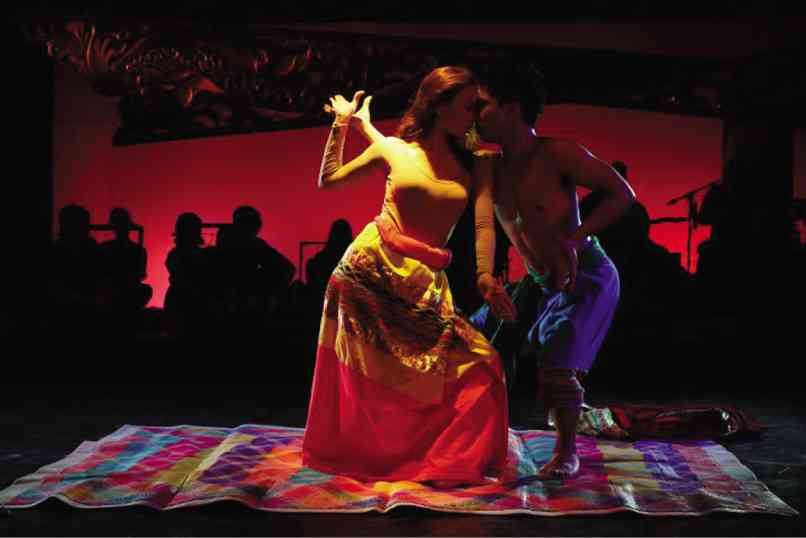
TANGHALANG Ateneo’s “Sintang Dalisay,” 2011, directed by
Ricardo Abad
Some students may regard it as a hobby until they graduate, while others see it as a bona fide drama course for a long-term career. Regardless of its practitioners’ motivations, the recent developments in university-based theater organizations have transformed campus theater into a serious training ground for students’ professional, intellectual and moral growth once they leave the academe.

First, a little disclosure. Starting sophomore year in college, I spent a huge chunk of my time with Tanghalang Ateneo (TA) when it was just an informal theater group finding its legs. During the mid-’80s in the Loyola Heights campus, there was no academic or “professional” gain whatsoever to it. Our extracurricular work then was not credited as part of the requirements of the curriculum. No one thought of listing in their CVs the skills gained from participation in the drama group. Every single centavo earned—it was a while before the university granted TA subsidy—went back to producing the next play.

We loved what we did and bonded with each other as a second family—and that was enough reason to go on. But, personally speaking, the lessons learned in those three years formed behavior patterns, intellectual mind-sets and an emotional resilience that served us well when we migrated to the “real world.”

More than a hobby
But then again, passion, regardless of the eventual prize, has always been the fuel that prods a theater person, student or practitioner alike, to do his best. Ricky Abad, our then moderator who would later become TA’s artistic director for the next 30 years, banked on it as he coached his core of students who were actually majoring in nontheater courses like business administration, finance, marketing, history, literature, communication arts, etc.
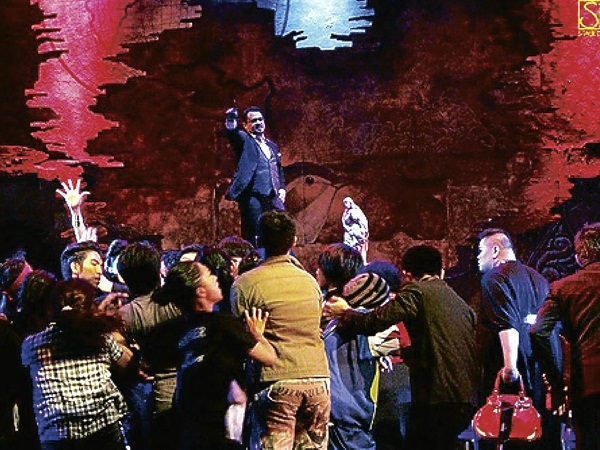
RECENT Dulaang UP productions: “Umaaraw, Umuulan, Kinakasal ang Tikbalang,” 2011, directed by Jose Estrella;
Abad himself ran on it. He was a Teatro Pilipino actor by night and a professor at the Ateneo’s Socio-Anthropology Department by day. It would take a couple of decades before he would launch the Fine Arts Program where colleagues like the late National Artist Salvador Bernal could formally teach theater design.

“We had to make theater more than a hobby for the students,” Abad says. “We could have an elective like acting classes which had only 23 students the first year.”

Among the prominent theater practitioners TA has produced are actors Nonie Buencamino, Richard Cunanan and Gabe Mercado; production designer Gino Gonzales, and award-winning playwrights Ron Capinding, BJ Crisostomo and Guelan Luarca. These days, when students do apply for membership in TA, “they see that they have to be professional. It’s not just a play,” says Abad.

Prominent neighbor
Dulaang UP (DUP), TA’s older and more prominent neighbor a jeepney ride away, started as the official theater arm to the state university’s speech, communication and theater arts course in 1976. From its founding by Tony Mabesa in 1976, it was envisioned as a cradle for future professionals.
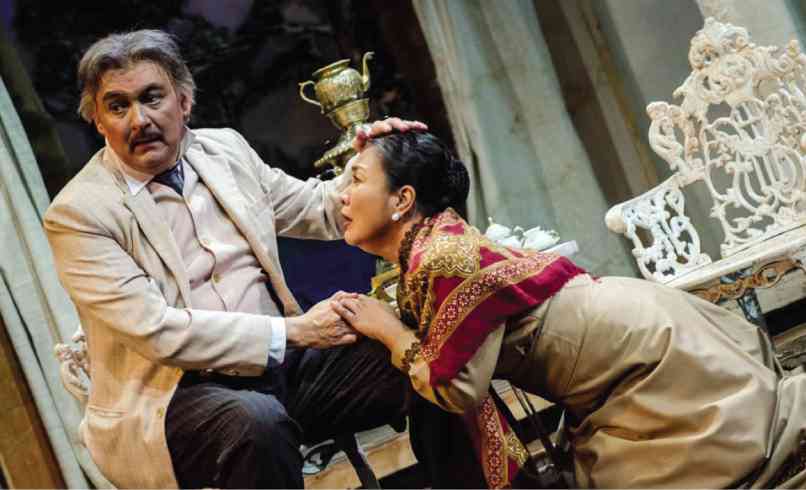
“The Seagull,” 2012, directed by Tony Mabesa
Many of the country’s leading thespians and theater practitioners today trace their roots to Dulaang UP: Bart Guingona, Irma Adlawan, Shamaine Centenera Buencamino, Frances Makil-Ignacio, Eugene Domingo, Stella Cañete, Ces Quesada, Jon Santos; playwrights and directors such as Floy Quintos, Tuxqs Rutaquio, Dexter Santos, Dennis Marasigan; and other creative luminaries such as film director Aureaus Solito, Ballet Philippines artistic director Paul Morales and acclaimed international scenographer Clint Ramos.
Dulaang UP veteran and current artistic director Alex Cortez tells both parents and students that “theater is not just a hobby, but something that people can make a profession of. We explain to them why rehearsals end late—and they have to sign a waiver.”

Both DUP and TA members spend an average of three hours a day on production work after classes. This can increase once opening day nears. However, students cannot use the long hours to justify their missing classes or deadlines in other subjects.

Cortez makes it plain to his students: “This is the kind of world you are entering. If you cannot make it here, you cannot make it out there.”

Newfound skills
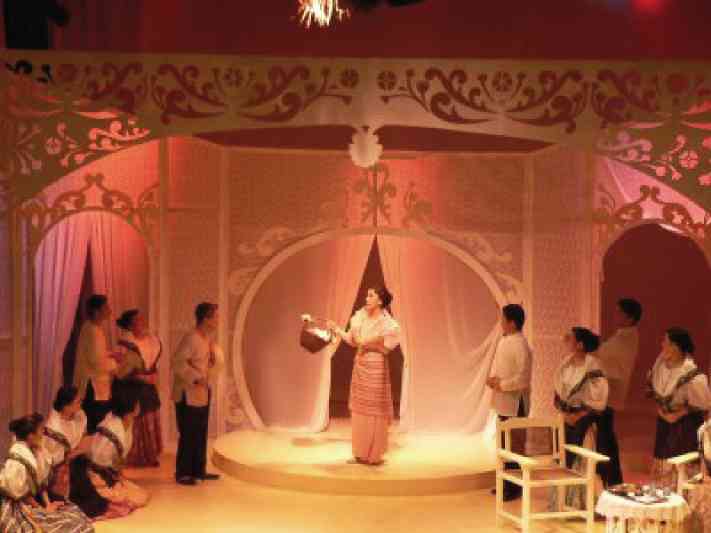
“Atang,” 2008, directed by Alex Cortez
While recent DUP and TA alumni try to make their mark in the theater world on and offstage, others use their newfound skills in performance, presentation and production management in other fields such as advertising, events, public relations, call centers and education. The growth of professional theater outside campus and the international opportunities offered to Filipino theater actors by productions like “Miss Saigon” have increased the interest of many students in the art.

Such that the UP Theater Arts Department has created a certificate course for applicants who may have failed the UP general entrance exam but passed the department’s auditions. Cortez explains the difference and the benefits: “The certificate offers hands-on instruction in theater without the theoreticals. We teach the students the ropes of production management and performance.”

Meanwhile, Abad has also been beefing up his training program for TA students through the Fine Arts Program, and the
occasional coaching of TA alumni and colleagues and friends from the theater industry and the Cultural Center of the Philippines, and also DUP alumni who are getting involved with TA plays.

“Right now, we are working with guest artists like Myra Beltran and Floy Quintos. In the past, I collaborated with Badong [Bernal] and Nonon Padilla. I believe that collaboration is essential to make the theater companies grow; it invites new resources and ideas and also makes the students work under different artists.”

Expanding his students’ horizons can also come by breaking through the usual campus parameters, including the international linkages. Cortez plans on creating linkages with other schools like Carnegie Mellon to “bring their students here and train them in theater and vice-versa. We can reach out to other countries such as Australia and the UnitedStates.”
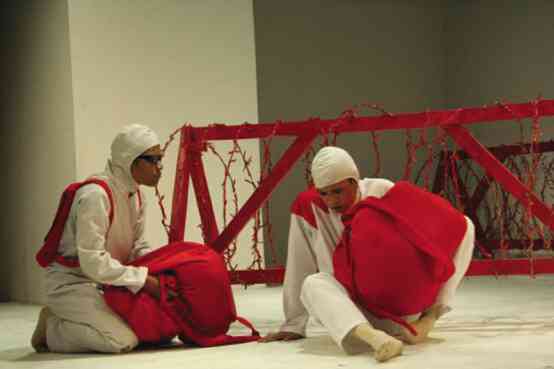
TANGHALANG Ateneo’s “The Death of Memory,” 2007, written by Glenn Sevilla Mas, directed by Ricardo Abad
International festivals
Meanwhile, Abad has been slowly bringing some of his TA students to participate in workshops and perform in international university-based theater festivals based in India, Singapore, China and, recently, Vietnam. Some of these international organizations have also invited him to direct their plays.

He admits, “My confidence and that of my actors increased. It does not matter if you are acting opposite artists from Hong Kong, China or Singapore. This is cultural exposure—the students see the styles of different schools and theater companies.”

Ateneo and the students help raise funds for their transportation while the host universities provide venue, food and training. Abad says, “We’d like to do this every year if we can find the money.”

Right now, TA and Ateneo’s fine arts program do things under a partnership; Abad still dreams of placing his group under an official theater program.

“This can help bring in more resources and you’d have someone from the school handling the finances, for example. Right now, it’s the student officers handling it, and there is usually a turnover.”

Cortez also wants similar, greater exposure for his students outside of the UP area. Thus, the blockbuster DUP production “Orosman and Zafira” had a successful run at the SM Mall of Asia last year.

More adherents
Support has been increasing for both organizations’ efforts. Interestingly enough, in the next few years, both DUP and TA might be moving to their own new individual buildings, which will have their own rehearsal spaces and theater venues. They need that space, because their efforts at establishing a professional training ground for new generations of theater artists appear to be gaining more and more adherents.

Cortez looks back: “When I started, there were less than 50 students for the entire theater course. Now we have 150 for the four years. And students now are becoming interested not just in acting but in the technical aspects like production management, stage management and lighting design.”

“How does theater equip the student?” Abad muses. “He learns integrity of the work, discipline of the craft, beating the deadline, the capacity to improvise. Theater is also collaborative—you have to learn to work with people, even those you don’t like.”


Tuesday, October 22, 2013

THEATER REVIEW: Dulaang UP's 'Adarna' - a familiar legend suddenly rendered unfamiliar

By Cora Llamas
Published in the Philippine Daily Inquirer, August 3 2013

The young hero Don Juan facing off against a giant.What kept the audience’s attention was how the familiar cliches and tropes of the folk tale were rendered with clever sleight-of-hand tricks.
“Adarna,” the recent Dulaang UP production of the well-known Filipino folk tale that was adapted for the stage by playwright Vlad Gonzales and directed by José Estrella, turned out to be more of a coming-of-age story of its young princely hero Don Juan (Fitz Bitaña). Perhaps it would have been more accurate to retitle it to something akin to the seemingly impossible labors of Hercules, or the wondrous journey of Odysseus.
The titular bird and its main participation in the storyline were only played out in the first act. By the second act, it just hovered in the background as a mystical companion and/or fountain of wisdom that helped keep the play moving along by pointing our hero in the right direction.

More fanciful
The familiar tale of the kind but sick king Don Fernando (Greg de Leon), who sends out his three sons and heirs apparent to find the magical bird for its healing powers, is done by the first half. The second half is an even longer and more fanciful quest which takes Don Juan all of seven years not just to find the bird, but to explore a far greater world beyond his kingdom of Berbanya, a realm filled with magic and mayhem.

And he takes the audience with him along for the ride. Along the way, he matures, secures a bride (or several candidates for the position), and in a sense becomes more ready, emotionally and intellectually, to assume the throne.
Pure fantasy

This was a recipe for a romp, and the production and its young cast made no bones about it. Except for fleeting appearances here and there, the Adarna was rarely seen and, truth to tell, was hardly missed. In this two-hour-and-a-half theatrical narrative, Don Juan would bring down a one-eyed giant, defeat a slithering snake, swim to the depths of a murky sea, and venture deep, deep down into the center of the earth.
The mythical Adarna bird reimagined as seven maidens with golden voices and colorful plumage
This was fantasy at its purest and, along with the beauty of a script spoken like poetry with background music to match, one could just, in a sense, “sit back and enjoy the show.” This “Adarna” was meant to be a spectacle, smartly written and with humor in all the right places, if slightly overlong.
What did keep the audience’s attention was how the familiar cliches and tropes were rendered with clever sleight-of-hand tricks. There were many of them, actually, and a second viewing seemed to be called for just to fully appreciate the techniques applied. Nor was it only a matter of the production designer having been given a bigger budget to put in more bells and whistles, or the equivalent of falling chandeliers.

Simple innovations
The innovations could be simple, but in their own quiet way stunning. The proverbial drop into a thousand-feet hole using only a rope was implemented with a ball of light on the stage and a couple of actors performing as doubles. Duplication of bodies was again used, this time with half-a-dozen look-alikes wearing the same costume, to mirror either a magical creature’s omnipresence or faster-than-light travel. The battle with the giant was made possible by interplaying the actor playing him on one side of the stage with lighting effects that simulated another actor’s overgrown shadow on the other.

To further make the play appeal and reach out to its young audience, current idioms and catchphrases were interspersed with the classical Tagalog script and, more often than not, had the crowd roaring.
“Adarna” paid slight homage to local and foreign pop culture in some of its devices. Don Juan’s victory against the giant echoed that now classic scene in the first Indiana Jones movie where the swashbuckling hero’s surprise tactic felled in a second the fearsome swordsman before him.

Missing its mark
The play started with a bang and on a high note, and it could have ended the same way. Unfortunately, and this is where it missed its mark, “Adarna’s” ending was thematically opposite to what had largely transpired before it. To avert a political crisis that occurs in the aftermath of Don Juan’s victorious return to his father’s kingdom, Don Fernando elevates him to heir apparent.

The play left it at that, leaving an ominous tone as the hero now prepared to confront his new role. But this ending opened a whole new can of worms which “Adarna” did not address. Will the two resentful brothers not respond with another form of treachery, if not outright rebellion? Why this sudden brooding atmosphere that seemed to question Don Juan’s ability to rule his kingdom?

The change in tone was jarring and baffling. The early parts of the play made no pretensions about the youthful, feel-good and occasionally comic approach to the original material. Even the two treacherous brothers had their funny moments. Without the proper creative and emotional preparation that could have laid the foundation for this sudden and inexplicable downbeat moment, the audience was left groping in the end, intellectually and emotionally.

Consistency could have made “Adarna” soar. Instead, it left questions even the wise mythical creature at its center would have found difficult to answer.


Monday, October 21, 2013

THEATER REVIEW: In "Collection," the Banaue rice terraces are for sale - and you believe it

By Cora Llamas
Published in The Philippine Daily Inquirer, February 23 2013


Master auctioneer Carlo Vibal (Domingo) in a climactic moment in the play. PHOTO FROM THESTAGEDOORCANTEEN.TUMBLR.COM
The poignantly silent or subdued moments in Dulaang UP’s “Collection” are what hit you like a fist to the stomach, or make that sense of disquiet creep under your skin. Probably because they are few and far between, amidst endless scenes of bragging auctioneers, swaggering fashionistas, the raving show-biz crowd and half-a-dozen big players who just want to outshout everyone else.

Subtlety holds no premium for the larger-than-life characters in this play who make no bones about their agenda and announce it to the rest of the world: The industrialist Don Manolo (Leo Rialp), international jeweler Tatiana (Alya Honasan), beauty magnate Stephen Yan (Roeder Camanag) and creative genius Alphonse (Alexander Cortez).

They’ve lorded it over our society for decades—and their kind, for centuries—and will gladly throw the public some bread and circuses just to keep them happy, contented and at peace. The circuses are your favorite talk show, your next trendy fashion line, your next popular movie, while the bread can amount to a measly contest win of P40,000.

And master auctioneer Carlo Vibal (Jeremy Domingo) who can probably sell you your own grandmother with the right hype, obliges them with one spectacular sale after another.

Able direction
In this fictional futuristic world brought to life by Dexter Santos’ able direction, our national patrimony, from Rizal’s novels to the Banaue rice terraces, is being sold to the highest bidder. In the guise of making our heritage more accessible to those who can’t afford to go to the nearest tourist spot or the museum, Don Manolo will be building a theme park to house the Chocolate Hills transplanted straight from Bohol.

That is probably why the message of the play hits you during those all-too-few quiet moments.  In one of the most telling scenes, Carlo reluctantly admits his guilt at the violation of another national treasure.  Manolo assures him “You will get over it.” Almost a heartbeat later, Carlo shrugs his discomfort off: “I already have.”

SCENE from Dulaang UP’s ongoing “Collection,” directed by Dexter Santos. VLADIMEIR B. GONZALES/CONTRIBUTOR
What triggered the auctioneer his momentary pangs of conscience was the discovery of an almost lifelike body beside the next national icon he was going to sell: The youthful, innocent Hermana Augusta Beata (Teetin Villanueva) seemingly sleeping beside a centuries-old carved statue of the Lady of Lost Souls, both of them still not giving in to rot and decay after centuries.

Vibal could ably ignore a hundred protesting tribesmen and their student supporters, but the presence of this hibernating guardian brings back the memories of the blood, sweat and tears that hundreds of our ancestors had shed for it.
The body of the Hermana Augusta is history incarnate, not quickly dismissed, not even after it disintegrates into ashes seconds after its discovery.

Apt model
One can argue that a centuries-old statue may not quite equal the spectacle of a sale of the Banaue rice terraces. True, hype can accomplish that (and this point would have been more convincing if the advertising done for the Virgin was glossier and downright more commercial).

But playwright Floyd Quintos could not have chosen a more apt model for his theme—the quest for a national soul, or the fight to regain it.

Leo Rialp, Alya Honasan, Jean Judith Javier, Alex Cortez, Jeremy Domingo, Jules dela Paz and Jacqui Amper lead cast of “Collection” PHOTO FROM THESTAGEDOORCANTEEN.TUMBLR.COM
In compelling flashbacks that show us the history of the creation of the Virgin, the Hermana symbolizes the uncorrupted purity of the Filipino soul. Wars can be fought for it, honest spiritual souls may love and protect it, the Inquisition may persecute it, and the people it serves can alternately venerate and turn against it. But throughout this tumult, the statue’s ivory remains as perfectly preserved as the Hermana’s nubile body.

Convert that embodiment of the national psyche into crass commercialism, though, and the statue deteriorates and the Hermana’s body disintegrates. It is a sin that not all the science in the world can explain, and an enigma that the student protester Gus (Red Concepcion) wants answered.
The quest for immortality is echoed in the quest for power and riches by Tatiana, Alphonse and the government lackey Helena. Yan, meanwhile, wants to study and literally capture the mysterious processes of the spirit, that he can then convert into a wellness product. If this Tsinoy balikbayan represents the future, his competitor Don Manolo is a relic of our colonial past, using his remaining affluence to endlessly collect treasures that will disprove his fading glory.

War of words
The engaging war of words between Manolo and Yan is but a preview of the real but quietly played showdown between the spirit of the Hermana and Vibal. Domingo plays to near perfection his conscience-stricken modern pragmatist, and he finds his match in Villanueva’s ruthless simplicity.

In this fatal dialogue, no quarter is given, and none asked. Not to cast any aspersions on Quintos’ fine work, but one wonders if this exchange could have been more moving had the Hermana answered in her native tongue.

Santos keeps things rising to a crescendo, until all hell breaks loose. The end may have been inevitable. To a certain degree, it can also make you lose track of the many characters that you had invested in.

Only after the smoke clears does the audience see what has happened to them individually. A little crowd control could have given us our own individual time with each character, even if it were only in their final seconds. However, all of them are caught in the stampede, their personalities and interests drowned in history’s final payback. And maybe that’s the final point that Santos wanted to drive home.

“Collection” runs until March 2-3, with 10 a.m. and 3 p.m. shows, at the Wilfrido Ma. Guerrero Theater, Palma Hall, University of the Philippines Diliman. Call Dulaang UP 9261349, 9818500 local 2449, 4337840 and look for Camille Guevarra or Samanta Clarin.